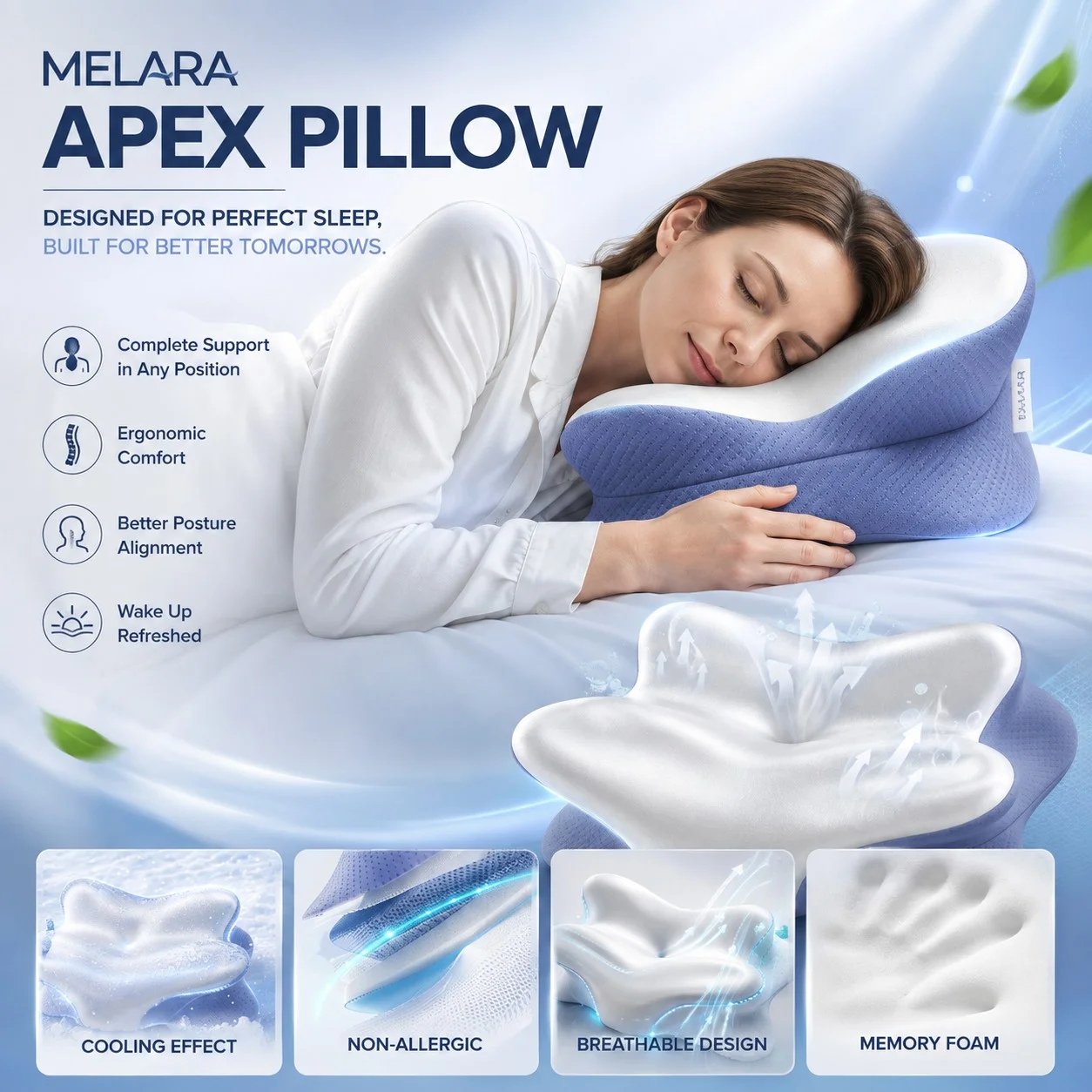
What the Melara Apex Pillow is designed to offer
The Melara Apex Pillow is presented as a contoured sleeping pillow for people who want a more considered fit than a flat, one-shape option. Its curved profile and raised areas are intended to give the head and neck a place to settle, while its central contour invites you to pay attention to how your own shoulders, sleeping position, and usual pillow height fit together. It is a sleep accessory, not a medical device, and a sculpted outline does not by itself promise a particular result for every sleeper. Use the product images as an introduction, then confirm materials, dimensions, firmness, care, and delivery with the seller before ordering.
The supplied product artwork highlights memory foam, a cooling feel, a breathable design, and a non-allergic positioning. These are useful features to investigate, rather than substitute for complete specifications. Foam formulation, cover fabric, ventilation construction, allergen testing, and temperature performance can vary between products. Ask for the exact materials and independent evidence behind any particular claim if it matters to you. This guide separates what the supplied images show from what a buyer should verify, so you can approach the product with interest while still making an informed decision.
Start with your sleeping position and body shape
Your usual sleeping position is a helpful starting point, not a rule that overrides personal comfort. Side sleepers often look for a pillow that fills the space between the shoulder and the head without pushing the neck noticeably upward. Back sleepers may prefer a lower, more even cradle that lets the head rest comfortably instead of tilting forward. Stomach sleepers commonly prefer very little height because excess lift can feel awkward. These are general considerations, not measurements for the Apex Pillow: it is important to ask for actual product height and shape measurements and compare them with the pillow you already use.
Shoulder width, mattress softness, body proportions, and the way you position your arm can all change what feels supportive. A pillow that suits one person in a household may not suit another, even when both sleep in the same position. If you switch between your side and back overnight, consider whether the shape provides comfortable options for each position rather than expecting yourself to stay still. When available, take account of the seller's return or exchange arrangements before making a purchase. A period of adjustment may be normal, but discomfort is a reason to pause and reassess, not something you need to push through.
Understanding contour, height, and alignment
The contour of a pillow can guide where your head rests, but the right contact should feel natural and relaxed. Think about whether the higher and lower areas of a sculpted pillow match your posture, whether the middle supports your preferred position, and whether you can turn your head comfortably. You should not need to crane your neck, prop yourself up with your shoulder, or fight the pillow's outline throughout the night. Product photographs are useful for understanding the general silhouette, but they cannot show how that silhouette will sit with your mattress, shoulders, or preferred way of sleeping.
Do not assume that a contour makes the pillow universally ergonomic or guarantees spinal alignment. Those terms can mean different things and should be supported with useful product details, not only promotional phrasing. Ask the seller for a side-view measurement, the height at the relevant support areas, and guidance about which part of the pillow is intended for each sleeping position. If you experience persistent pain, numbness, a diagnosed condition, or a recent injury, seek advice from a qualified health professional rather than relying on a consumer product description. Individual needs matter more than a generic recommendation.
Memory foam: feel, rebound, and familiarization
Memory foam commonly responds to pressure and warmth, allowing a pillow to feel more shaped after the sleeper settles. Some people appreciate that closer cradle; others prefer a quicker, more buoyant response. The label alone does not explain firmness, density, temperature response, or how quickly the foam returns to shape. Ask for a description of the actual Apex Pillow material, and whether it contains a single molded foam core, several layers, or other construction. If you have enjoyed memory foam before, compare those details with the pillow you know rather than assuming that every foam product will feel the same.
A new pillow may feel different from the one you have been using, particularly when its silhouette is visibly contoured. Give yourself time to notice how the pillow feels when you first lie down, whether your head stays comfortably supported in your usual position, and whether you wake feeling at ease. This is personal observation, not a diagnostic test or promise of improved sleep. Keep your previous pillow available while you assess a new fit, follow the seller's guidance, and pay attention to any product-specific return window. Small, careful changes are often more useful than repeatedly switching between many unfamiliar pillows in a single night.
Cooling and breathable comfort in Taiwan
A cooling claim is especially appealing when a bedroom feels warm or humid, as it can in Taiwan's changing climate. The product images describe a cooling effect and breathable design, but a pictured airflow illustration is not a temperature measurement. A pillow does not replace a cool, well-ventilated sleep environment, and the exact feel depends on its cover, foam, room conditions, bedding, and the person using it. To understand what the claim means, ask whether the surface uses a special fabric, ventilation channels, a removable cover, or another specific construction, and whether care instructions preserve those properties.
Breathability, heat transfer, and a cool-to-the-touch sensation are related but not identical. A fabric might feel cool at first while the entire pillow responds differently over a longer period. Look for precise descriptions rather than broad promises, and ask about the cover composition and washing requirements. Lightweight bedding, airflow, and a comfortable room temperature can also affect your overall experience. If you are particularly sensitive to heat, check the seller's policy and ask whether they can explain how the pillow performs in ordinary use. Do not treat a cooling illustration as clinical evidence or a guarantee of temperature regulation.
Allergy-aware decisions and material transparency
The supplied imagery also describes the pillow as non-allergic. Before treating that phrase as a safety certification, find out exactly what it means for this particular item. Ask which materials touch the skin, whether the cover can be removed and washed, whether the foam has a noticeable odor when new, and whether any independent testing or documentation is available. If you have a known allergy or sensitivity, compare the complete material list with your own needs and contact a healthcare professional where appropriate. A general product description cannot determine whether a material will be suitable for you.
Check whether the listed specifications cover both the outer cover and the inner filling, and look for clear care instructions. The people sharing a bed may have different sensitivities, so it can help to check each person's requirements before ordering. If a seller cannot confirm a detail that is essential to your safety, wait until it can be clarified. Clear product information is a practical part of a good buying experience; it should not require a buyer to guess from a photograph, slogan, or short promotional description.
Getting the pillow ready and caring for it
Before purchase, confirm how the pillow arrives, whether it is compressed for shipping, and how long it should rest after unpacking. If it arrives tightly packaged, follow the included instructions and provide enough room for any recommended expansion. Let the pillow air out according to the maker's directions, especially if you notice a new-material smell. Avoid putting foam into a washing machine, dryer, direct heat, or strong sunlight unless the official care label explicitly allows it. Not every cover is removable, and not every foam core is washable, so confirm which parts can be cleaned.
Protecting the pillow with an appropriate breathable pillowcase and following the stated cleaning schedule can help keep the sleep area fresh. Use mild, approved cleaning methods for the relevant part, and let it dry fully if any spot cleaning is permitted. Do not apply bleach, solvents, or fragrances without checking compatibility. Store it in a clean, dry place away from moisture and excessive compression. Care can affect product life and may be governed by the seller's warranty; the manufacturer's printed care instructions should always take precedence over general advice in this guide.
What to check before ordering in Taiwan
The purchase link for this page is supplied as a product-information destination. Before paying, confirm that the listing is active and displays the same product name and photographs. Check the final price and currency, any delivery charge, estimated dispatch and arrival dates for your address in Taiwan, shipping methods, local tax or customs requirements where applicable, and whether a parcel will need a signature. Read the seller's returns, exchange, cancellation, and warranty terms in full. A promotional page may not show every charge or condition, so use the checkout total and seller's written terms as the most relevant source.
Compare the information on the listing with the details you want to confirm: the pillow's dimensions, height, fill, cover material, firmness guidance, available variants, care instructions, and what arrives in the package. Check whether the seller explains how to contact support if an item is damaged, delayed, or different from its description. Save a copy of the order confirmation and policies that apply on the date of purchase. This site does not set prices, operate the destination listing, or guarantee availability, stock, delivery timing, or a particular seller's customer-service response.
A simple way to compare pillows
If you are comparing the Apex Pillow with a traditional pillow, start with the questions most likely to affect daily comfort: What sleeping positions does the shape accommodate? What is the loft at the areas that support the head? What is inside the pillow? Is the cover breathable, removable, and washable? Is the firmness described clearly? Can you try it or return it, and who pays return shipping? Writing down the answers makes comparison more practical than relying on a single product claim. Consider your existing pillow's height and feel as a reference, not as a standard that another design must copy.
Also compare clarity and convenience. A well-described product with a sensible care guide and transparent service terms may be easier to evaluate than one with more impressive but unclear wording. Think about the time you spend in bed, whether you need the pillow to travel, how much maintenance you are willing to do, and who else may use it. A higher price is not evidence of a better personal fit, and a long feature list is not a substitute for precise measurements. Look for details that help you imagine the item in your actual bedroom and make an informed choice.
Who might explore a contoured design
A contoured style may be worth exploring if you are curious about a defined place for your head to rest, would like to compare a sculpted profile with a conventional pillow, and have enough information to assess the shape and materials. The photographs offer an introduction to the Apex Pillow's look, but you will still want details about its dimensions and feel. If you share a bed, make the choice together where possible: each person has their own comfort preferences, and buying two identical products should not be assumed to solve two different needs.
It may not be your preference if you want to mold, scrunch, or fold your pillow into many shapes, or if you strongly prefer a very soft or very low profile. Some sleepers like a pillow that stays in a defined shape, while others enjoy adjusting a loose filling. Neither approach is automatically right for everyone. Check whether the product can be returned after opening before deciding how you would like to try it. The most useful question is not whether an advertised pillow is universally best, but whether this particular pillow's verified features fit your own priorities and terms.
Make a thoughtful, informed choice
Choosing a pillow is a small but personal part of setting up a comfortable bed. The Melara Apex Pillow's advertised contour, memory-foam construction, cooling feel, and breathable positioning offer several starting points for questions, but the exact specification and shopping conditions should come from the seller. Read those details in advance, compare them with the way you sleep, and do not rely on general sleep-product copy to address a medical concern. If you are unsure, ask the seller a specific question and keep the answer with your order information.
This Melara Apex Pillow Taiwan page was created to collect an approachable guide and useful contact details. It does not claim to test or certify the item, and it does not invent a price, warranty, dimensions, foam density, certifications, or delivery guarantee. Details can change over time, so verify them directly at the product page before ordering. Your comfort, budget, care preferences, and confidence in the seller are all valid parts of the decision. Taking a little time to check them can help make the choice feel calmer and better informed.